
Advanced in Reading
It was a beautiful, sunny day in October as I boarded the plane for my first-ever business trip with Rosen Publishing. I had recently joined Rosen as their curriculum and instruction specialist after 20 years as an elementary teacher and literacy coach. Our decodable series, The Decodables, had recently been added to The Reading League’s list of approved decodable texts, giving me the opportunity to attend The Reading Conference. As a first-time attendee, I was eager to learn from the best in the literacy field.
Settling into my seat, I put on a podcast to pass the time during the flight. The latest episode of Melissa & Lori Love Literacy had just been released, featuring an interview with Nancy Young and Jan Hasbrouck, co-authors of the (then) newly released book Climbing the Ladder of Reading & Writing: Meeting the Needs of ALL Learners (2024). I had heard of the book and seen the infographic that inspired it, but I hadn’t yet read it.
For the next 55 minutes, I listened as Young and Hasbrouck shared their insights on supporting ALL learners in their literacy development. One thing stood out to me the most: Nancy Young’s focus on supporting those Advanced in Reading (AIR). When Young openly addressed the importance of meeting the needs of advanced readers, it was music to my ears! Advanced readers are rarely discussed in literacy conversations, yet one of the most common questions I hear from teachers is: “What about my students who are excelling?”
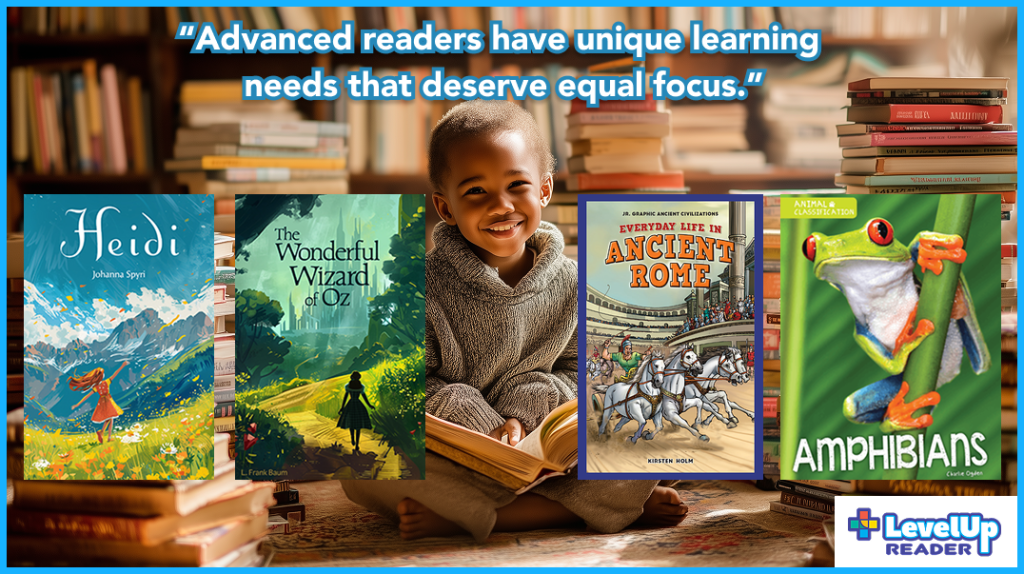
The importance of explicit phonics instruction has gained significant attention, particularly after the release of Emily Hanford’s Sold a Story. This investigative report revealed that many classrooms across the country lack systematic phonics instruction, leaving numerous students without the foundational skills necessary to become proficient readers. As a result, there has been a growing emphasis on supporting struggling readers, which is important given that the latest National Assessment of Educational Progress (NAEP) results show 4th grade reading proficiency is only 41%. However, this raises an important question: What about students who enter school already reading at an advanced level? Should they receive less attention simply because they are ahead? Advanced readers have unique learning needs that deserve equal focus. By understanding their development, educators can better support their growth and ensure they remain engaged in meaningful literacy experiences.
Now, here’s where the story gets exciting. I arrived in Charlotte, NC, and checked into the hotel. We were able to walk across the street to the convention center for early check-in, even though the conference wouldn’t officially begin until the following day. After checking in, I wandered back to the hotel and met my colleague at the hotel restaurant for a quick bite before heading to bed. As we waited to be seated, who should be standing at the host stand but THE Nancy Young! No joke! There she was, in the flesh. Just a few hours earlier, I had been listening to her on a podcast, and now she was right in front of me. And guess what? She asked to join us for dinner! I spent the next hour chatting with Nancy (we’re on a first-name basis now) about how she got into studying advanced readers, the origins of the Ladder of Reading & Writing infographic, and more.
Needless to say, with the serendipity of the weekend and the obvious expertise of this literacy pundit I just had dinner with, I purchased my own copy of Climbing the Ladder of Reading & Writing. Upon returning home, I got to reading. When I got to Nancy’s chapter, “Chapter 13: Advanced in Reading (AIR),” I was struck by all the ways that LevelUp Reader, Rosen’s adaptive reading platform that I’ve been working so closely on, can support students who are advanced in reading. Before sharing all the ways LevelUp supports advanced readers, let’s learn about what it means to be an advanced reader and what instruction should include.
What Makes an Advanced Reader?

Young’s Ladder of Reading & Writing (2012, 2023) provides a valuable framework for understanding the spectrum of reading development. It illustrates the “continuum of ease” in learning to read and write.
As you look at the infographic, you will see, learners in the red band—about 10–15%—require intensive, explicit, code-based instruction with frequent repetition. Those in the yellow band, accounting for about 40–45% of learners, also benefit from explicit, code-based instruction but may not need the same level of intensity or intervention as those in the red band.
Next, in the light green band, are learners who may require some form of explicit instruction for spelling and writing, but reading development may entail broader learning opportunities. They make up 35–40% of all learners. Finally, the dark green band represents the 5–10% of learners who learn effortlessly, although for some of these children certain spelling and writing instruction may be important. Although advanced, these learners run the risk of being overlooked by educators. After all, they are already ahead of where they need to be.
However, it’s important to recognize that early and more effortless reading skill mastery does not necessarily mean a student is equally advanced with every component underpinning the comprehension of complex text. Advanced readers still need instruction tailored to their development—just a different type than struggling decoders.

“Early and more effortless reading skill mastery does not necessarily mean a student is equally advanced with every component underpinning the comprehension of complex text.”
Key Characteristics of Early Advanced Readers
Students who are Advanced in Reading (AIR) share some common traits. Typical characteristics include:
- Early Reading Skills: Most may begin reading well before formal instruction starts, even teaching themselves to read. These readers often enter kindergarten with the ability to read most things set in front of them (Young & Hasbrouck, 2024).
- Automatic Word Recognition: They often decode words quickly and recognize new patterns. They may require no instruction at all (Young & Hasbrouck, 2024). Their visual word form area is highly developed.
- Large Vocabulary: Many advanced readers have an extensive vocabulary (Rogers, n.d.). This may be due to exposure to complex texts and strong background knowledge. The more you read, the more you know!
- Advanced Comprehension: These readers “read and comprehend text two or more years beyond their chronological grade placement” (Wood, 2008).
Supporting Advanced Readers in the Classroom Using LevelUp
Chapter 13 of Climbing the Ladder of Reading & Writing takes a deeper look at the instructional implications for Advanced in Reading (AIR) students. As I read, I was struck by how closely my new learning aligned with the product I had been deeply involved in. While LevelUp Reader is designed to support all readers, its features have the potential to truly benefit advanced readers.
One common challenge is that advanced readers may not receive instruction that matches their abilities. If left unchallenged, they may disengage, affecting their social and emotional well-being along with their academics (Brighton, Moon, & Huang, 2015). Here are some strategies to support them:
Offer Choice in Reading
Allowing students to choose books that challenge their thinking—whether through content or complexity—helps maintain their engagement. Above-grade-level reading materials should always be accessible. LevelUp Reader offers over 3,800 authentic books for all users. Readers can explore books that interest them, regardless of their grade level or the Lexile measure assigned to the text. This accessibility gives advanced readers the freedom to choose and encourages them to push their reading skills beyond grade-level expectations.
Encourage Depth, Not Just Speed
Advanced readers may quickly breeze through texts, but it’s important to guide them in analyzing themes, figurative language, and author intent to deepen their understanding. The comprehension quizzes at the end of each book on LevelUp Reader challenge advanced readers to apply these skills to more rigorous, complex texts. The reports provided to teachers offer valuable insights into each reader’s ability to analyze the text, enabling them to provide customized instruction that supports the growth of advanced readers.
Integrate Writing Challenges While Supporting Foundational Skills
Encouraging students to write analytical essays, book reviews, or their own stories helps foster critical thinking. However, it’s important to remember that even advanced readers may still require explicit instruction in letter formation and spelling. These foundational skills often develop later than reading ability. Fortunately, as Nancy shared with me, this instruction can be integrated into more advanced lessons on word study, morphology, and etymology (personal communication, April 22, 2025). By using LevelUp Reader’s authentic and rigorous texts, teachers can select words from books that their advanced readers are both interested in and capable of understanding—providing meaningful opportunities to support spelling and handwriting within engaging content.
Also, LevelUp’s extensive collection of authentic texts helps students build background knowledge—an essential foundation for writing. After all, students can’t write about topics they haven’t learned!
To further support writing development, LevelUp Reader provides graphic organizers to help students plan their writing, as well as books that teach different genres, grammar, and language skills through explicit instruction. The constructed response questions at the end of higher-level comprehension quizzes require deeper text analysis that is certain to provide a challenge to advanced readers.
Encourage Collaboration with Other Advanced Readers
Facilitating in-depth discussions through literature circles allows readers to engage meaningfully with their peers. To enhance this experience, consider grouping students across different classes or grade levels, giving them access to more advanced readers. The online nature of LevelUp Reader makes it easy to provide common advanced texts to students in different classes.
Recognize and Respond to Social and Emotional Needs
The National Association for Gifted Children states, “Many gifted students may be so far ahead of their same-age peers that they know more than half of the grade-level curriculum before the school year begins. Their resulting boredom and frustration can lead to low achievement, despondency, or unhealthy work habits. The role of the teacher is crucial for spotting and nurturing talents in school.”
To keep gifted readers engaged and motivated, it’s essential to provide them with authentic, challenging material—such as the texts available on LevelUp Reader—that stimulate their thinking and prevent boredom. Classroom libraries that only contain on-grade-level books are often insufficient for meeting the needs of advanced readers.
Teachers must be attuned to the social and emotional needs of their advanced readers. Just as striving readers may face emotional challenges, advanced readers can as well. By implementing the strategies above and providing appropriate access to challenging texts, like those provided on LevelUp Reader, we can ensure that students who excel in reading receive the support they need—not just academically, but emotionally too.
Advanced readers need just as much intentional instruction as their peers. Understanding where they fall on the reading continuum—using frameworks like Nancy Young’s—helps educators and parents provide meaningful challenges that foster a lifelong love of learning. By engaging them in rich, thought-provoking literacy experiences, we support their growth not just as readers, but as thinkers.
I’m grateful for the serendipitous weekend that led me to meet Nancy Young and for the collaboration that has followed. Her message about the importance of addressing the needs of advanced readers is invaluable. As educators, it is our responsibility to meet the needs of all students. Thank you, Nancy, for your dedication to recognizing and advocating for advanced readers.
Brighton, C. M., Moon, T. R., & Huang, F. H. L. (2015). Advanced readers in Reading First classrooms: Who was really “left behind”? Considerations for the field of gifted education. Journal for the Education of the Gifted, 38(3), 257–293. https://doi.org/10.1177/0162353215592501
National Association for Gifted Children. (n.d.). Myths about gifted students. https://nagc.org/general/custom.asp?page=myths-about-gifted-students
Rogers, K. B. (n.d.). The educational needs of young gifted readers. Retrieved from https://idmforgifted.pbworks.com/f/EdNeedsYoungGTRdrs.pdf
University of North Carolina at Charlotte. (n.d.). Advanced readers. UNC Charlotte College of Education. https://education.charlotte.edu/resources/literacy-tips/advanced-readers/
Wood, P. F. (2008). Reading instruction with gifted and talented readers: A series of unfortunate events or a sequence of auspicious results? Gifted Child Today, 31(3), 16–25. Retrieved from https://files.eric.ed.gov/fulltext/EJ803362.pdf
Young, N., & Hasbrouck, J. (Eds.). (2024). Climbing the ladder of reading & writing: Meeting the needs of all learners. Benchmark Education.
Young, N. (n.d.). Dr. Nancy Young, Ed.D. Retrieved May 7, 2025, from https://nancyyoung.ca
